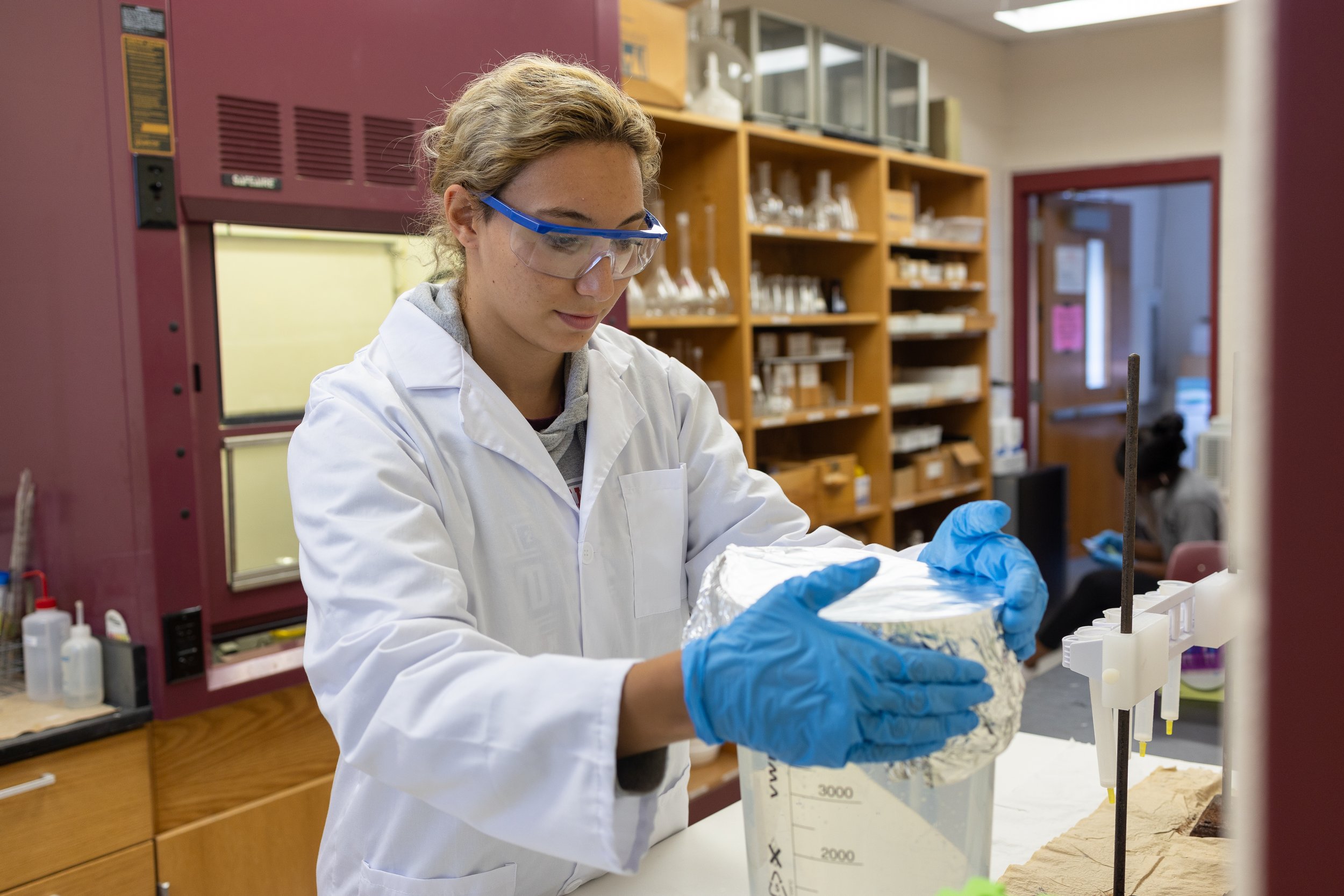
CAMPBELLSVILLE, Ky. – Campbellsville University’s Dr. Indra D. Sahu, associate professor of physics, has received a $459,976 grant from the National Science Foundation (NSF) for a project that will support research into the KCNE3 protein.
National Science Foundation (NSF) is a national government funding agency for scientific research. Recipients of the NSF research award are selected among several applications nationwide as per the NSF intellectual merit and broader impacts review criteria. Sahu is the principal investigator (PI) for the research. This research grant will support ongoing work to understand the protein KCNE3 protein and how it interacts with the potassium channel KCNQ1. The project is titled, “Investigating Structure and Dynamic Properties of the Potassium Channel Accessory Protein, KCNE3.”
KCNE3 is a protein that acts as a “regulator” for potassium channels, which are tiny pores in cell membranes that control the flow of potassium ions. KCNQ1 is a potassium channel protein that acts as a gate for potassium ions to move in and out of cells.
According to Sahu, this research grant will support additional insights into the relationship between KCNE3 and KCNQ1. The project will explore how KCNE3 behaves in cell membranes—especially in the presence of cholesterol—and how it interacts with KCNQ1. To do this, the research team will use advanced spectroscopy and computer-simulation techniques.
“The research outcome will advance our fundamental understanding of the KCNE3/KCNQ1 interaction and its function in channel gating. Additionally, this project will contribute to the development of new structural biology approaches.”
Additionally, the research will support student teaching and training, Sahu added.
“Students will be involved in both experimental and computational aspects of the project, gaining experience in science, technology, engineering and mathematics (STEM) research,” Sahu said. “The modern biophysics laboratory developed through this research project will enhance the educational facilities at Campbellsville University.”
“Students will gain valuable undergraduate education and research experience as part of this project.”
Dr. Harlan Scott, Associate Professor of Biology and Natural Science Division Chair, said, “receiving another competitive NSF grant underscores the high quality of the work of Dr. Sahu and those who contribute to his research program. The funding awarded to Dr. Sahu for his research will provide many enhanced opportunities for our students.”
Currently, eight students are working on the project. Six students recently presented their ongoing research findings at the Kentucky Academy of Science Annual Meeting on Nov. 21-22, 2025, in Louisville, Ky.
CU student Daniel Oriaku is one of the students participating in this research project who presented at the Annual Meeting. He described the project as “eye-opening” and a “valuable learning experience.”
Through this research, Oriaku said he learned how to use molecular dynamics simulations to study how disease-causing mutations in the KCNE3 protein affect its structural dynamics.
“This means I was taught a lot of hard and soft skills during this process,” Oriaku said. “Examples I can give are clear communication, asking important questions, and data analysis. I hope to use this experience as a launching point to get into other positions where I can have similar valuable experiences and grow academically as well as personally.”
CU student Conner Campbell, another member of the research team who also presented at the Annual Meeting, explained how the research team decided on their research topic.
“What led our group to researching this topic is that membrane proteins are very important to the proper functioning of human cells, and therefore, to the human body,” Campbell shared. “They are important to the point that it is estimated that a quarter of pharmaceuticals target membrane proteins.”
Campbell added that it is difficult to study their structural dynamics because they contain both hydrophilic and hydrophobic properties. This requires a membrane mimic, which replicates the structure and function of a biological cell membrane, to gather data.
“The difficulty of obtaining relevant data on this protein, as well as its importance to human health, is what led us to land on this topic,” Campbell said.
Campbell said the team is utilizing a method called site-directed spin labeling, a technique for investigating the structure and local dynamics of proteins.
“The reason we do this is because cysteine is one of two amino acids that contains sulfur, and the only one that has its sulfur atom exposed to where it can bond with other sulfur atoms, and our spin label contains sulfur, allowing us to have a disulfide bond, a very strong bond, at a particular area of the protein that can generate stable spin label required for our experiment.”
The team introduces specific mutations into the KCNE3. After the protein is prepared and tagged with a spin label, it is placed into a model cell membrane so it can be studied with electron paramagnetic resonance (EPR). By changing the types of lipids, the amount of cholesterol, the mutations introduced, or by adding its partner protein KCNQ1, researchers can examine how KCNE3 behaves under different conditions.
“We hope to utilize the data we have gathered to this point and data we will be gathering in the future, to better determine the structure and dynamics of this protein so that our conclusions can help those affected with diseases linked to mutations found in this protein.”
Dr. Monica Hardin, Assistant Vice President for Academic Affairs said, “Dr. Sahu is not only outstanding in his field of study but invests deeply in our students. We are grateful to him for creating research opportunities that allow students to grow in knowledge and experience with a steady mentor relationship.”
Campbellsville University is a widely acclaimed, Kentucky-based Christian university that enrolls nearly 10,000 students and offers over 100 programs of study, including certificates, undergraduate, graduate, and doctoral programs. CU is committed to academic excellence solidly grounded in the liberal arts, that fosters personal growth, integrity, and professional preparation within a caring environment.